What Making AI Jiten’s Featured Images in ChatGPT Taught Me About Prompting and Revising
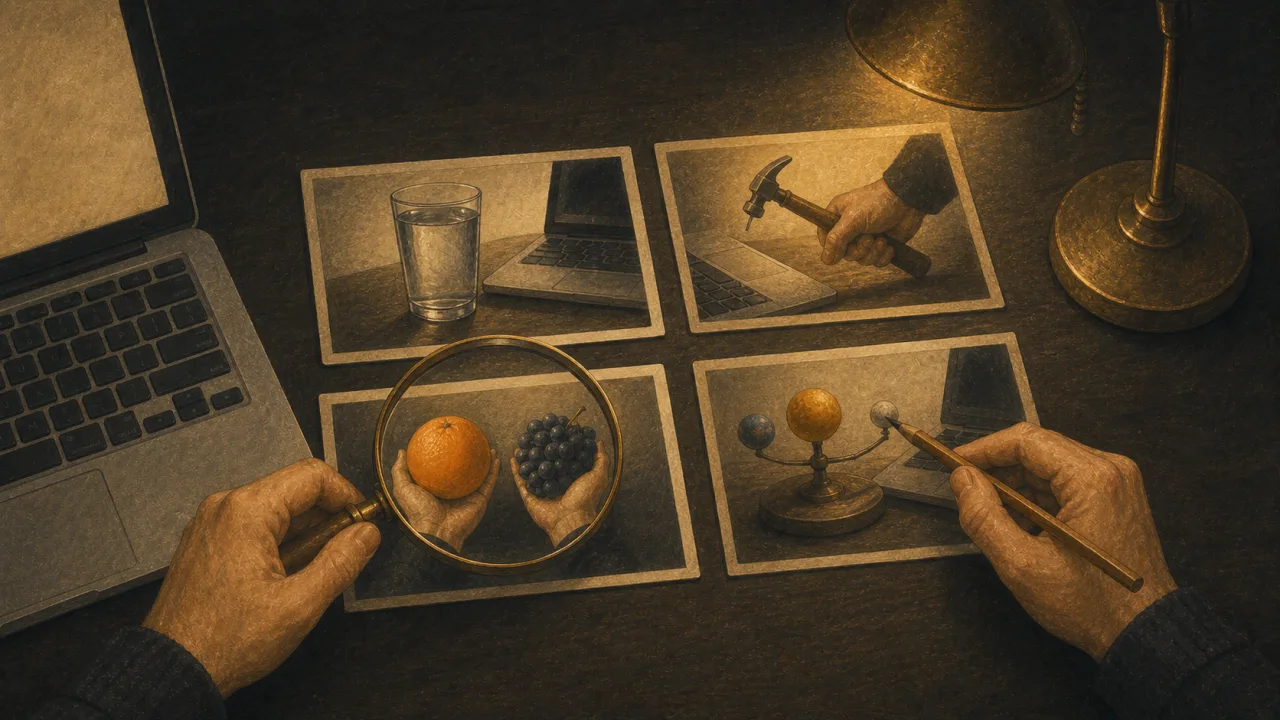
AI Jiten’s featured images are produced with ChatGPT’s image generation. At first they were unified around abstract visuals, but lined up in a list, the difference between articles did not come across. So partway through we switched to something with a little more humor — surface tension on a glass for a Mac running out of storage, a hand swinging a hammer beside a computer for AI development.
What producing several article images as one series taught me is that deciding in advance what stays the same and what changes matters more than landing a good image in one attempt.
Fix the visual world first
Changing the treatment from scratch for every article leaves the whole site unsettled. For AI Jiten we made a shared rule of dark backgrounds, warm lighting, a texture like slightly old print, and a framing centered on hands with no faces shown.
Breaking the fixed elements into words like this makes them reusable.
- Medium and texture: subdued hand-drawn illustration, paper grain
- Color: centered on black, dark brown, and muted gold
- Light: soft warm tones, like a desk lamp
- People: no faces, hands and torso only
- Ratio: 16:9 landscape for a blog, 1280×720px
- Text: none inside the image
With that settled, each new article only needs its central metaphor decided.
Make the difference between articles with one legible metaphor
Abstract light and shapes look AI-generated and, at thumbnail size, look alike. What worked for distinguishing them was translating the article’s content into a familiar object or action.
- A Mac out of storage: a glass about to overflow
- What was built with AI: hands assembling wood beside a computer
- Comparing two AIs: an orange in one hand, grapes in the other
- Model tiers: an orrery of sun, earth, and moon
- Using up a top-tier AI: a runner breaking the tape
The trick is not to have abstractions such as “AI”, “performance”, or “comparison” drawn directly, but to translate them into things everyone knows — glasses, fruit, tools, sport. A metaphor slightly on the exaggerated side works about right in a list.
Specify left, right, and movement concretely
For a comparison image, say “an orange on the left as you look at it, blue grapes on the right”; for a runner, “running in from the left, body facing right”. Specify positions on the canvas. “A sense of comparing two things” alone gets important elements overlapping or placed the opposite way round.
When a laptop appears in the image, “an open laptop at the front left” and “the main subject on the right” keeps the composition stable. Communicating subject, position, orientation, and action as a set reduces the number of revisions.
Leaving faces out made the series easier to sustain
Faces draw the eye, and when features and expressions change between articles, that is all that stands out. For AI Jiten we moved the camera close to the hands and kept faces out of frame.
This also avoids fixing an impression of a person too firmly, and makes it easier for readers to place themselves in the picture. Beyond removing the face, saying “keep the neck and hands a natural skin tone and texture” and “move the camera close enough that no face enters frame” also helped avoid unnatural anatomy.
For revisions, ask for one thing, not a rebuild
Once a composition you like appears, rewriting the long prompt from scratch changes the parts that were working. Being explicit about what to keep and what to fix — “same framing, just move the camera in so the face is out of shot”, “match only the junior’s neck to the skin texture of the hands” — proved effective.
ChatGPT lets you upload an image and describe the change in words, and supports editing a selected area. Thinking of it as someone you art-direct in conversation, rather than a tool that outputs a finished piece in one go, makes it easier to use.
In summary: settle the editorial policy before the prompt
What matters for a series of images is not writing a clever prompt every time. It is deciding the visual world you hold constant, the metaphor you vary per article, the prohibitions such as no faces, and what to preserve when revising.
For AI Jiten, moving from abstract AI imagery to images that tell the content through familiar objects made the list far easier to scan. Using an image AI not only as someone who draws but as a production partner you can consult repeatedly under the same editorial policy makes the look of the whole site easier to hold together.
Reference: OpenAI, “Images in ChatGPT”. Features and specifications are as of July 2026.