EU AI Act Transparency Rules Are Now in Force: When Does Smartphone AI Editing Need a Label?
On August 2, 2026, the transparency obligations in the EU Artificial Intelligence Act began to apply. The rules are intended to help people recognize when they are interacting with AI or seeing images, audio, video, or text that has been generated or manipulated by AI rather than created entirely by a person or recorded as a real event.
The European Commission page that prompted this article was published on May 8, 2026, when the Commission opened a consultation on its draft guidelines. That consultation closed on June 3, and the Commission published its final guidelines on July 20. This article therefore reflects the final guidelines and Article 50 of the AI Act, not just the earlier draft.
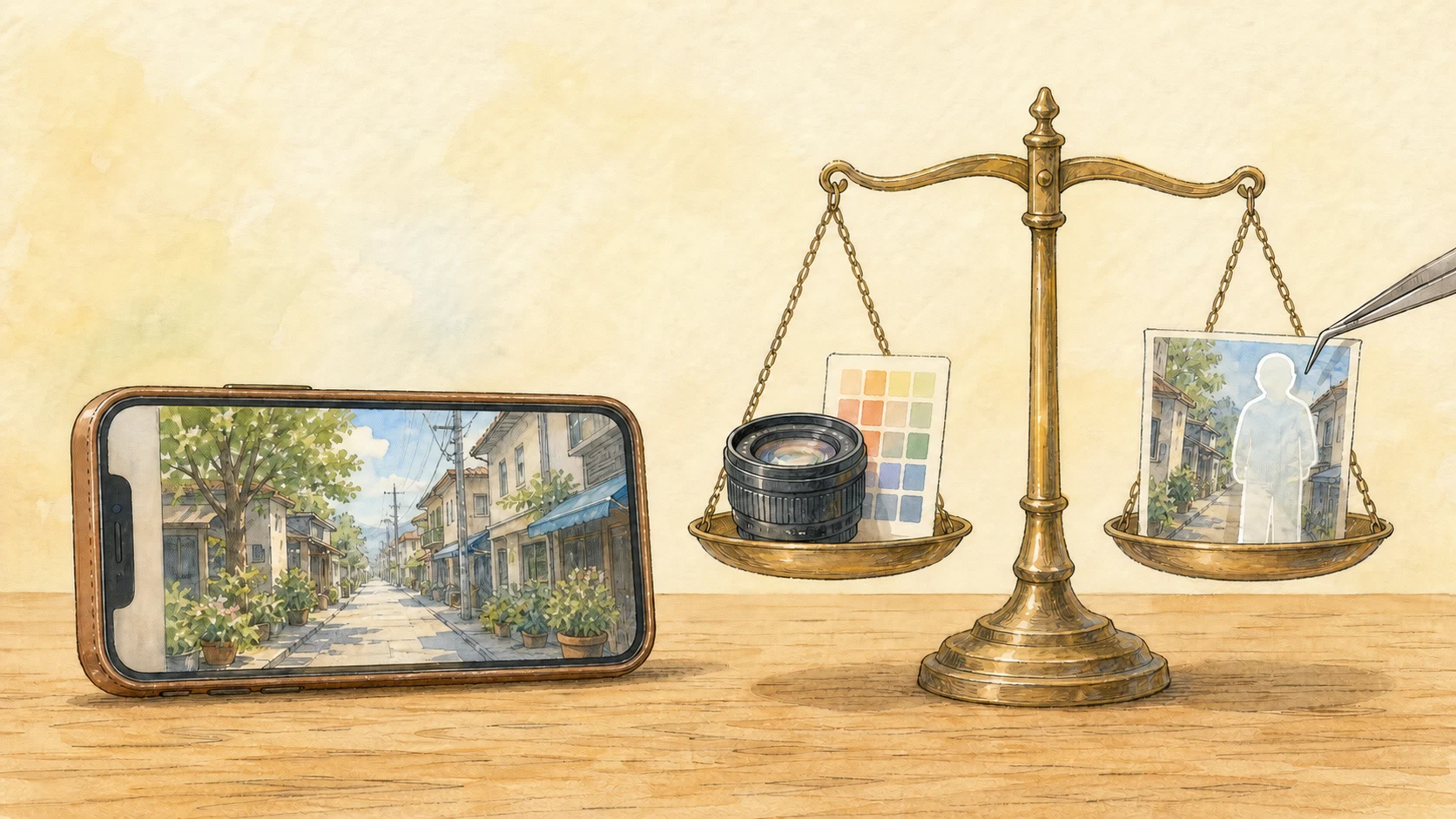
It is easy to understand why a realistic impersonation, a cloned voice, or a fake video of a politician giving a speech that never happened should be disclosed. The difficult part is that modern smartphones already use AI automatically whenever we take a picture. They adjust brightness and color, reduce noise, stabilize motion, and combine multiple frames—often without the photographer doing anything beyond pressing the shutter.
The dividing line is not simply whether AI was used. The key questions are whether the meaning or intent of the original photo, audio, or video was substantially altered, and whether the result could mislead people into believing it is an authentic record of reality. Minor color correction and noise reduction sit closer to the exemption. Adding or removing people or objects in a way that changes the meaning of an event, or substantially changing a face, body, or voice, moves the content toward the disclosure side.
This article provides a general overview of the EU AI Act for everyday users. It is not legal advice for any particular case.
The four transparency obligations under Article 50
Saying that “all AI content now needs a label” is too broad. Article 50 places different obligations on companies that provide AI systems and on people or organizations that use those systems professionally.
| Who is covered? | What is required? | Common examples |
|---|---|---|
| Providers of AI systems that interact directly with people | Inform people that they are interacting with AI | Chatbots, AI agents, and AI avatars |
| Providers of generative AI systems | Add machine-readable marks and make AI-generated or manipulated outputs detectable | Image, video, audio, and text generation services |
| Deployers of emotion-recognition or biometric-categorization systems | Inform the people exposed to the system that it is operating | Systems that infer emotions from facial expressions |
| Professional deployers of generative AI | Clearly disclose deepfakes and certain AI-generated public-interest text | Advertising, journalism, corporate communications, and monetized content production |
There is a limited transition period for one part of the rules. Generative AI systems placed on the EU market before August 2, 2026 have until December 2 to comply with the machine-readable marking obligation in Article 50(2). Content created before August 2 does not have to be labelled retroactively, although the Commission encourages voluntary disclosure where possible.
A “provider” is generally the person or organization that develops an AI system—or has one developed—and places it on the EU market under its own name or trademark. The duty to build machine-readable provenance information into a smartphone or generative AI service primarily belongs to the provider.
A “deployer,” by contrast, is a person or organization that uses an AI system under its authority in a business, trade, occupation, or professional activity. Companies, advertising agencies, and media organizations may be deployers, but so may freelancers and individuals who regularly gain economic benefits from their work.
Not every automatic smartphone enhancement needs a label
Article 50(2) requires AI-generated or manipulated content to be detectable in a machine-readable format. It also provides exceptions when an AI system merely performs an assistive function for standard editing or does not substantially alter the input data or its meaning.
The final guidelines give a fairly detailed list of edits that may fall within those exceptions:
- Minor cropping, color correction, brightness adjustments, and sharpening
- Noise reduction, compression, and format conversion
- Removing dust spots caused by a lens or sensor, and correcting red eye
- Limited video stabilization and adjustments to volume or dynamic range
- Minor horizon correction and conversion between color and black-and-white
- Non-substantive pixel filling for aspect-ratio adaptation
- Privacy and accessibility measures such as blurring or pixelating faces
Typical smartphone processing—such as HDR, night-mode noise reduction, color and exposure correction, and light stabilization—therefore sits closer to standard editing when it does not change what the photograph means. The mere fact that AI was running inside the phone does not mean every picture must be labelled “AI edited.”
The boundary is whether the edit changed the meaning of reality
The same feature can be treated differently depending on how it is used. The guidelines focus less on the name of the tool and more on the resulting content, the message it communicates, the context in which it appears, and what its audience reasonably expects.
| Smartphone or editing operation | How to think about it | Likely direction |
|---|---|---|
| Slightly brightening a photo and correcting color or noise | The subject, event, and message remain the same | Closer to the standard-editing exemption |
| Removing one passerby from the background | It may be minor in a holiday photo, but could change the meaning of an accident, protest, or news image | Depends on context |
| Light skin retouching | The question is whether it remains comparable to makeup or ordinary photographic correction, or materially changes the person’s appearance | Minor correction may be exempt; major changes move toward disclosure |
| Swapping a face, or substantially changing body shape or skin color | The person’s appearance or the facts of that moment are materially changed | Machine-readable marking is more likely required; visible disclosure may also be needed if it is a deepfake |
| Generating and replacing the sky or background | A clearly aesthetic effect may pose little risk, but using it as evidence of a place, weather condition, or event changes the meaning | Depends on purpose and audience expectations |
| Styling only the background of a product photo | The effect may be minor if it does not misrepresent the product’s appearance, performance, or use | Closer to the exemption |
| Making the product itself look better or more capable than it really is | The edit may affect a buyer’s understanding and decision | May qualify as a deepfake |
| Adding or removing people or objects to create a scene that never occurred | The event or its truthfulness has been changed | Closer to mandatory disclosure |
Removing a passerby is a useful example. The guidelines say that minor editing of background details may not turn an image into a deepfake when it has little effect on how people perceive the content’s authenticity. The same removal from an image documenting the size of a demonstration, the scene of an accident, or a news event could change what viewers understand.
A practical question is: “Would someone who did not know about this edit reach a different conclusion than they would from the original?” If the answer may be yes, the edit is approaching the disclosure boundary.
A deepfake is broader than a malicious impersonation
Under the AI Act, a deepfake is AI-generated or manipulated image, audio, or video content that resembles an existing—or realistically plausible—person, object, place, entity, or event and could falsely appear authentic or truthful.
The final guidelines give examples including a fake speech by a person resembling a politician, cloned voices of newspaper podcast presenters, a realistic synthetic avatar of a company CEO, and even an advertisement that makes a product appear more attractive or higher quality than it is in real life.
The creator’s intention to deceive is not the only factor. The assessment also considers how closely the content resembles reality, its substantive message, where it will be published, the reasonably foreseeable audience, and whether that audience expects the content to be authentic.
By contrast, an image of a mythical creature flying over a landmark, an advertisement in which animals speak like humans, or a fictional game environment would not usually be understood as a record of reality. The guidelines list such obviously unrealistic content as examples that do not constitute deepfakes.
Personal social posts and professional or monetized use are treated differently
For everyday users, an important detail is that the AI Act excludes the obligations of natural-person deployers when the AI system is used in a purely personal and non-professional activity. The final guidelines even list a person privately creating a deepfake and sharing it on social media as an example of activity covered by this exclusion.
That does not mean private users are free to copy someone else’s face or voice without permission. Privacy, personality rights, copyright, defamation, fraud, platform policies, and other national or EU laws may still apply. The exclusion also does not remove the AI provider’s separate obligation to add machine-readable marking where Article 50(2) applies.
The following uses move closer to professional deployment:
- Creating advertising or public-relations material for a company or client
- Delivering AI-assisted images, video, or articles as a freelancer
- Using the content on a YouTube channel or social account that regularly generates revenue
- Using it in information that may affect decisions about products, services, investments, health, or politics
Businesses outside the EU may also fall within the AI Act when they place AI systems on the EU market or when their AI system’s output is used in the Union. At the same time, the final guidelines say that incidental, unforeseeable, or unauthorized downstream use in the EU should not by itself trigger the rules for a third-country provider whose system was not placed on the EU market. EU-targeted advertising, work commissioned by an EU client, and services intended for EU users deserve a case-specific review.
Professional deepfakes require a disclosure people can actually see
A provider’s machine-readable mark and a deployer’s disclosure to the audience are different things. When a professional deployer publishes image, audio, or video content that qualifies as a deepfake, it must clearly disclose that the content was artificially generated or manipulated no later than the first exposure. Metadata alone is not enough if people cannot perceive the disclosure.
Specific wording is often more useful than a vague “AI used” label. For example:
- “Part of this image’s background was generated or altered with AI.”
- “The person’s video and voice were synthesized with AI.”
- “This video contains AI-generated material depicting an event that did not occur.”
Artistic, creative, satirical, and fictional works are not completely exempt if they contain deepfakes. However, the disclosure may be made in an appropriate way that does not hamper the display or enjoyment of the work. Films and music videos therefore have some flexibility to design a disclosure method appropriate to the work and the platform.
Does every AI-assisted article need an “AI generated” label?
Article 50 also covers AI-generated or manipulated text published for the purpose of informing the public on matters of public interest. Politics, justice, fundamental rights, public safety, health, the environment, consumer safety, economics, science, and cultural developments may all fall within this broad category.
There is an important exception for text. Even if AI assisted with the writing, a label may not be required when a person substantively reviews or exercises editorial control over the content and a natural or legal person holds editorial responsibility for its publication.
Spell-checking and a superficial grammar review are not enough. The reviewer must examine the sources, verify the facts, and have the authority to change or reject the substance of the text. For an explanatory article like this one, AI may help organize research or prepare a draft, but the author still needs to read the official material, edit the article, and take responsibility for publication.
For more on evaluating sources around fast-moving AI news, see How to Keep Up With Generative AI: Using Primary Sources, Social Media, and YouTube Wisely.
Six checks users can make before publishing
- Keep the original: Save the unedited photo, audio, or video separately from the modified version.
- Describe the edit in one sentence: Distinguish “I corrected the color” from “I removed a person and generated a new background.”
- Ask whether the meaning changed: Check whether you altered a person, object, place, time, number of people, spoken words, product feature, or other fact that may affect a decision.
- Identify the context: Separate private family use from professional, advertising, journalistic, or monetized activity, and consider whether the content is intended for people in the EU.
- Disclose from the start when necessary: If the content may qualify as a deepfake, explain the AI generation or manipulation somewhere people can actually perceive, such as the post text or caption.
- Preserve provenance information: Do not remove an AI label or metadata added by a service or device without a good reason.
When in doubt, it is safer to ask whether the edit could affect the viewer’s decision than to search for the narrowest legal reason not to disclose it. A label does not make an otherwise unlawful manipulation legal, and adding a label does not give anyone permission to violate another person’s rights.
I support transparency rules—but not one warning label for every AI-touched photo
I understand the case for requiring transparency around malicious impersonation and fabricated events presented as real. It is unreasonable to place the entire burden of detecting AI-generated content on the people who see it.
At the same time, if every automatic smartphone enhancement carried the same warning, disclosure fatigue could make genuinely risky manipulation harder to notice. The final guidelines take a practical approach by distinguishing minor technical correction from changes that affect meaning or truthfulness.
The boundary is still not a precise numerical threshold. The guidelines repeatedly stress that the assessment depends on the specific context. The guidelines are also non-binding; only the Court of Justice of the European Union can ultimately provide an authoritative interpretation of the AI Act.
Conclusion: focus on whether the edit changed how people understand reality
The transparency obligations in the EU AI Act do not ban AI-assisted content or require a label on every smartphone photo.
- Ordinary color, brightness, noise, and light stabilization adjustments sit closer to the exemption
- Adding or removing people or objects, substantially changing a face, body, or voice, and fabricating events move toward disclosure
- The same edit may be treated differently in a holiday photo, a news image, or an advertisement
- Purely personal use and professional or monetized use do not have the same obligations
- For AI-assisted public-interest text, substantive human review and editorial responsibility matter
There is no reason to fear every automatic enhancement. The most practical habit for ordinary users is to pause before publishing and ask: “Did this edit change the information someone would use to judge what really happened?”
Sources checked on August 3, 2026
- European Commission: Consultation on the draft transparency guidelines (May 8, 2026)
- European Commission: Final guidelines on the implementation of Article 50 (July 20, 2026)
- European Commission: Q&A on the transparency obligations under Article 50
- European Commission: Quick Facts on transparency rules for AI systems
- AI Act Service Desk: Article 50
- AI Act Service Desk: Article 2 on scope
- European Commission: Code of Practice on Transparency of AI-Generated Content
The scope of the rules, the Commission’s guidance, and the marking or labelling features offered by individual services may change. Businesses operating in the EU or handling high-stakes projects should check the latest official information and obtain professional advice where appropriate.